



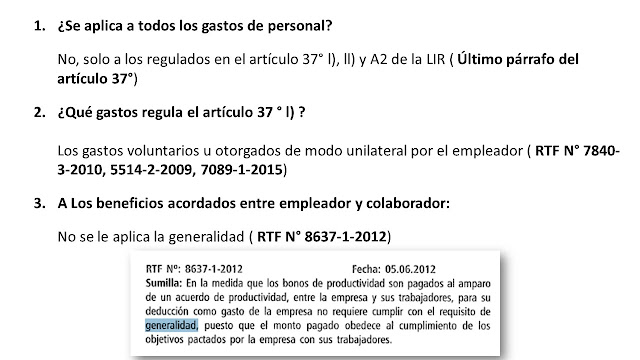
The generality criterion is an indispensable requirement for the deductibility of certain personnel expenses in the Peruvian Income Tax. Unlike other expenses that only require causality, benefits granted to employees must comply with this principle to be accepted for tax purposes.
What does Generality imply?
Generality does not mean that the benefit must be granted to all employees of the company. It refers to the benefit being common to those employees who are in similar situations or belong to the same hierarchy or category:
- Hierarchy: A benefit can be granted only to managers.
- Seniority: Only to those with more than 10 years in the company.
- Geographical area: Only to employees of a specific branch.
- Responsibility: Only to those who handle cash funds.
Support for Generality
For SUNAT to accept the expense, the company must be able to demonstrate the objective criteria that justify why the benefit was granted to one group and not another. It is recommended to have:
- Internal policies or benefit regulations.
- Employment contracts specifying the conditions.
- Memorandums of group communication.
Importance according to the LIR
According to the last paragraph of Article 37 of the Income Tax Law, expenses for bonuses, allowances, gratifications, and similar are deducted in the fiscal year in which they accrue, provided that the payment is general. Failure to comply with this criterion leads to the disallowance of the expense by the tax administration.
Originally published by Juan Carlos Arana Huayta on TaxControl.